Link to Research Script: https://docs.google.com/document/d/1i-V7D5DJ0n9Ujh_enPM9UNRSQyXdCTALf55hXvHIbkY/edit Clear references to film history, theory or genre topic Unfortunately film history,theory and genre was something I forgot to mention in my research script .This would have been important when discussing the film The City of God. Since violence was taboo in Brazilian cinema, this film became very important because it was the first to break many boundaries. In addition though Goodfellas was not the first crime and violence film, it was part of the many gangster films that Warner Brothers had produced and became very successful. It The film did well in the box office and became wall known across the country. Clear engagement with the target audience, scope and depth of argument By presenting a clear research question and picking several scenes in which that support this research question I was able to give the depth to the argument. In addition I both compared and contrasted the films, so too look at both were very important because it is significant to point out how the films accomplished their independentsuccess from each other, this highlighted in my genre foci. Other then the things previously listed I am not sure how else to target my audience besides clearly explaining my points and arguments. Clear use of sources and structure of the script Not only was it my first time doing a research script, it was also my first time using this format, so I was first very confused when first starting the script. In addition I was absent when the class went over the assignment so I was very lost in directions for this assignment. However in the end after talking to several students I understood the structure, though it was completed different to any other format I have ever used for a report, after doing this assignment I am completely comfortable and acknowledged the steps of the research script and the overall format. In addition the sources that were given especially the ones we had to do for homework helped to develop my ideas and understand the deeper means of violence in the film and how this effected the rest of the film as well as the deeper meaning behind it. Video and audio elements are detailed clearly and coherently described and linked The video and audio elements were very detailed and coherently described and are linked in my research log. After watching each film, I went through the film again skipping to the points in the film that would help support my research script. After choosing all the scenes I wanted, I then recorded these sections individually to properly analyze. After I then was able to record exactly what occurred in this scene, which included the shots, background music and any dialogue that the narrator was saying at the time to put in the visual and audio columns of the research script. To find the background music I looked at each films soundtrack and found the correct song that was playing at the time. . Both my films clearly relate to the topic, since a major theme of City of God and Goodfellas was the corruption of all authority weather it was the police or the gang, all power seemed to be in the wrong hands, since this was a major issue displayed I based my topic on it. By basing my topic on such a important part of both films it was easy finding insightfulcomparisons that brought out the deeper meaning. Furthermore since both my films were of the same genre, this helped in comparing because much similar themes were already there as well as some of the similar events in the plots. However even though their were many similarities, there were also many aspects that were different, I also pointed these out because I felt it was important in describing their differences due to their origins.
Independent Film Research My strengths in approaching the research were using the resources provided to me and available this included several websites recommended and offered to the class. When doing assignments such as the Research Script, I felt that I needed more training in the knowledge of the focuses.I have a general knowledge of some of the main focuses, but others I had to research. Many of the times I was not sure what I was suppose to be looking for even after I had picked my focus, so more writing and comprehension with these focuses in film would have helped me a lot when writing the main research script. Oral Presentation Experience
My strengths in approaching the oral presentation in the class was defiantly having clear and accurate knowledge of the the criteria in which we were studying. Studying the many of the aspect before hand in the film had made the process of the oral presentation go by quite easy. Making a outline was one of the main works that had helped me on the oral presentation, it had provided a organization of all my analysis and it made be able to through my presentation more fluidly. Some of the areas that I still need to work on in my preparation for this assessment would be practicing my presentation, I did a couple run throughs, but I feel like this was not enough, my overall presentation could have been more clear and understandable if I would have practiced more. Lastly I felt like their was enough support and training involved in the oral presentation, I understood everything and directions were clear and precise.
Production Experience This semester as well as the whole year I accomplished the role of cinematographer. This semester I tried to learn from films and other works of cinematographer to perfect mine. I was able to look at other films and try to incorporate their artistic achievements into my films and learn from it. Areas that I feel we still need to work on in our production is clarity,throughout our films this year there has always been some confusion, better planning in preproduction might prevent puzzling the audience,such as in Her Decision when it was never announced in one of the scenes that the baby was suppose to be her boyfriend's cousin, so many viewers believed this was her baby.More film watching would help in creative process in building two collum script
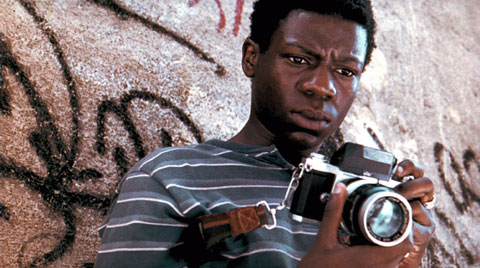
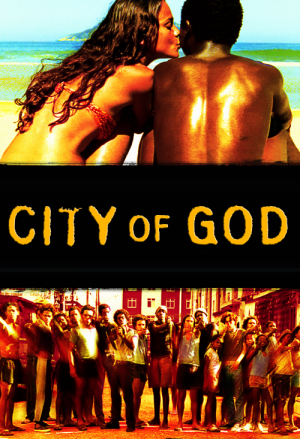
What is the main ideology communicated in the film? It is evident that violence not only propels the plot of the film, but also expressed a large message for the need of social change. The film explains why violence has become such a significant role in favelas, boys are taught at a young age in order to get what is desired or necessary, it must be done with violence and they are therefore rewarded. This is forced into their morality at such a young age that any other way is useless or just known. Other ideology portrayed in the film, as this article describes it "if you live by the gun you die by the gun, but if you avoid violence and retain some honest values and ambitions you escape". Rocket is the essence of this ideology. The film ends with Rocket finally perusing his dreams of becoming a photographer and being able to escape from the favelas. While on the other hand, almost all of the characters that indulge in violence or any type of legal activity dies or is killed from it. What film traditions, genres, historical and political influences are communicated in the film. One of the genres that City Of God falls under would include Brazilian Cinema.However it is important to acknowledge that the film used several evident genre features and altered them to fit into the film, altering them to more vibrantlocations. Furthermore traditions of the film would include the connections to mainstream cinema, these factors include production vales, genre and narrative. In addition according to this article since The City Of God gained so much popularity, it was considered a political with a provoking message. The only main historical influences communicated in the film was through the flood explaining the increase of population the favelas, but even this historical event was only shortly mentioned. In addition there are no political influences in the film because during the 1960s and 1970s the pass public were unaware of Brazilian society that made these slums. What focus area interests you for your personal research? Areas that interested me in my personal research included the editing of the film and how one of the main editing techniques is montages. The way montages are used in the film sends a powerful message to the audience and is very provoking. Highlighting the section in the film, where the two arrival gangs are handing children guns, the next several shots consisted of many bloody corps shown in the favelas. In addition I also found the analysis of the characters to be very interesting. According to this article Rocket represent hope, throughout the movie the audience sympathizes with him because he can't play foot ball, get a girl or get revenge on his brother's murder. Despite this he grows up absent from violence and is able to escape it.
The article first expresses the reality within this film, that the portray of Brazil, highlighting Rio was accurate, this includes the the large gap classes in this region, which includes a small wealthy class and an enormous indigent class. Furthermore the film also used real events and people adapted from a large biographical novel. Moreover the article also discusses the roles of women in the film. Women were mostly victimized by unjust and cruel men. However a couple of women persuade their lovers in leaving their gangs through their
sexual hold, however these attempts are a complete fail and result in both men's death. The article also expressed the way of life in the film, that violence is a large part of manhood, one runts state" I smoke, I snort, I've killed and robbed, I'm a man. This also explains how violence was manifested onto each generation, that the self-worth of a man is measured on how many violently acts he has committed. Giving violence a sense of almost tradition of manhood.A boy must commit several acts of violence in order to be considered a man, additionally to move up in life an older men die, younger men move up and take their places as well as their statues. The article then further converses about the following:
Narrative Rocket is the main narrative of the film. His voice is constantly explaining what is going on in the film. In the beginning of the film he describes the origin of his favela and portrays a sense of isolation when describing the civilians, he states, "For the powerful our problems didn't matter". Throughout the film, the narrative through Rocket closely correlate to the cinematography. one example from the article includes when Rocket is very young and he is talking about his future in the favela and how he is terrified of getting shot, at this point to highlight his fear the shot turns into "a long shot of Rocket's back, positioning him as if within a gun sight".
Cinematography The Cinematography promotes a sense of disorientation when in the favela, especially in chase scenes,the camera is hand held and constantly moving, along with a fast paced edit. In addition through the usage of warlike cinematography, such as the shots through gaps and under objects as well as positioning subjects as if a sniper targets shots, the audience is able to feel the full effect of violence portrayed in the film, this cinematography also harmonizes with the narration of Rocket when he says "You got use to the living in Vietnam". This further pushes the sense of brutal violence that these characters are faced with. Edit
One of the important aspect of the edit include the portrayal of Rocket's camera as a gun. The article states, "The editing of the sequence suggests not only that Rocket survives by shooting the others, but that he is directly responsible for the deaths of those shot by real bullets."To further push the importance of this analogy, the photography's taken by Rocket which serves as a way of filming through his camera lens. In addition the edit also depicts the development in violence, such as when young boys go to gangs wanting gums, this then becomes a montage of fast paced medium close-ups of the boys and then fading into a slow-motion sequence of unusual sounds and images of dead people. This forces shock into the audience, because it is acknowledged that such a mass group of youths is part of this horrific violence
Genre This film is a Brazilian crime drama that depict the brutal life of citizens in Cidade de Deus, a suburb in Rio de Janeriro. The time of the film ranges from the end of the 1960s and the beginning of the 1980s. As depicted in this article "City of God offers a variety of explanations for the violence it depicts, but ultimately presents violence - within the city and within its characters - as something beyond representation, comprehension, or escape." Violence is the main tool utilized to get the message across in the film.
1. What Genre do you see want to use in this short film: horror, drama, comedy, etc.
The genre that I want to explore in the next short film would be a drama
2. What film or films will you use as your models? Include movie poster
The films I would use to model my short film would include Love, a drama about a man who is stick in space. The film explores isolation a and loneliness.As the film begins an astronaut is in space, he is doing research and has contact with people on earth. However later on the astronaut experiences technical difficulties with communication with his those who are helping him on earth. Finally after several days he loses complete contact with earth and is left alone for several years. The protaginist struggles staying sane given that he now has no one to talk to. he contemplates suicide and even attempts it, but is suspenseful.
3. Detail the conventions of the genre in terms of the following
a. Themes and Narrative Structure Themes in drama differ in so many ways. The themes I would like to focus in include several specific aspects such as
the horrific struggle of depression and constant fight to stay in a right state of mind.In addition just like the film Love the protaginist portrays the overall consumption of depression leading into tragic and unhappy ending. Narrative Structure would include a main character who the audience is focused on and how their obstacles change them.
b. Character/Acting Style
Characters are usually the center of attention when it comes to dramas. The whole film is focused around them and their barriers that they are facing. At the end of the drama a character or character's life has changed by overcoming a large obstacle. The audience usually only see the perspective of the main character and fully understand the plot and actions from this one person's point of view
c. Settings/Production Design/ Lighting
Dramas completly differ when it comes to setting, production design and lighting.An example would be a film where the begging of the film there is full luscious colors. Everything is bright and has a warm mood to it. As the protagonist slowly falls into a conflict we see lighting become darker and colors become dull. Setts would include everyday locations that you would usually see in real life. These sets are pretty simple and usually do not need a lot of design comapted to other generes such as horrer.
d. Cinematography
Cinematography would conveyemotion within the protaginist .
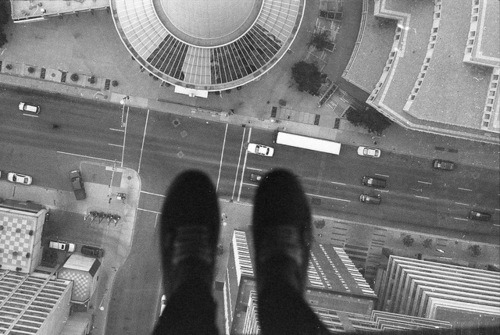
An example of an protaginist struggle with his depression is, when he stares blankly at the wall he imagines himself on top of a building. He is gets closer and closer to the edge but then he snaps out of his day dream.This is similar to the film Love when he images his death before he attampts it.
e. Sound Design
Sound Design would include a series of songs that help push the mood of the film during a specific section.For example in the beginning of the film there would be a upbeat pop song when the protaginist is finding life easy. When things take a turn for the worse music becomes slow and somber. This song will play during scenes when the main character is depressed and lastly at the end of the film when we makes his last decision
4. Logline: Give us a possible logline for you movie. It's 1 sentence that describes the whole movie-
A man tries to escape depression and indifference as his life crumbles but fails.
16–20 There is a coherent and detailed analytical evaluative interpretation of the extract, displaying
a good understanding of how meaning is constructed through the use of film language and a
good awareness of the extract’s relationship to the film as a whole. There is a clear
explanation for the selection of the extract. The critique shows a good awareness of the film’s
genre, its place in a broader sociocultural context, and gives a sound analysis of the director’s
intention. There may be brief elements of description but analysis will be thorough.
In my oral I mention a lot information about Alfred Hitchcock but I do not discuss how this connects to my extract or the film in general. In addition I point out themes but do not convey how these themes are actually portrayed in the film or the other films Hitchcock has done. I do discuss the social culture context such as production codes and some of the many aspects of the film that where completely new to the audience at the time, and name many of these examples. Furthermore I do connect this social culture context to my extract with Arbogast's murder and how much of it was actually censored. I do mention the director's intention with the original script with having Marion beheaded just as the story of the murderer Ed Gein. I do overall analyze the extract and how it affects the overall plot in the film.However when it comes to analyzing cinematography I do lack major terminology in describing shots. I also needed to connect my extract to the film alot better, the relationship between the extract and the film in general is very important! Much of the time I say "this shot" or "that shot", when I should have specified what type of shot this is. I do need to work on how fluent I am when talking, I stumble alot and constantly say "um" which is very distracting when trying to convey an idea.Lastly I fully explain editing techniques and point out significant shots and how this plays an element to hiding the murder's face. I need to work sounding more natural when I am talking, this is one of the reason my oral was so long, I had many pauses and times where I would have to repeat myself after saying something incorrectly.Overall I am in the 16-20 section of the rubric.
The extract I chose occurs 1hr 12min 14sec into the film. At this point in the film we see Arbogast has just integrated Mr.Bates and he is now entering a telephone booth where he calls Leila to tell her that he will further spend more time looking into Mr.Bates. Arbogast then goes back to the Bate's Hotel where he is murdered.
In this extract there is only one character that is focused on, this is detective Arbogast. In this section of the film, detective Arbogast is represented as being as a minor character that propels the plot through his murder and leading the audience into the development of Mr.Bates's mother. Furthermore Arbogast is a static character that allows the audience to see how ruthless the murderer is, which who at this point in the film the viewer believes is Norman Bates's psychotic mother. The spotlight was not on Arbogast until this moment in the film because Arbogast's role is seen more of a rise in action then he is an actual character, for this reason the audience does not fell much sympathy when he is killed. For example there is much more despair when Marion is killed then their is when Arbogast is even when he is depicted as an innocent man seeking for the truth. After his death(not in the extract) their is development in plot when Sam and Lila go to the police and they find out that Norman's mother is dead. The audience is now put on the edge of their seat, however this suspense was caused by Arbogast's murder, without it Lila and Sam would have never discovered this information and went to the hotel to see for themselves
Arbogast's style of acting is very normal and acts as a common male detective. Arbogast does not have a unique style of acting because this would distract the audience and take away from the main points of the plot. For example if Arbogast was a very likable character the audience would feel sympathy and this would take away attentions from Marion's murder. Or if Arbogast was an unliked or malicious character the audience would believe he deserved his horrific ending, this would also take away from the mother's compulsive killing and would some what justify it.There is a lot of dramatic irony as he slowly walks up the stairs to the Bate's home, the audience acknowledges how much danger he is in, but Arbogast himself is completely clueless as he takes another step to his death. In addition the murderer's acting, who the audiences believes is the mother, is very forceful and vicious when she is attacking Arbogast, she never hesitates, this further pushes the idea of how violent and insane the she really is.
The overall extract is shot in a formalistic style. In the first scene of the extract Arbogast is in a telephone booth. Arbogast is the main focus during this time in the film and for this reason he falls on the rule of thirds in this scene to the left and almost all of the others. This fast fall off creates more interesting shot as Arbogast tells Lila that Bates's mother might have had something to do with Marion's disappearance. Arbogast is correct, but he doesn't know that this impact was the extent of murder and this is why the scene is set in more of a dramatic way because his words are true but ignorant .In addition when Arbogast goes back to the Bates's Motel, their is slow pacing within the shots as they build up to his murder. This consist of several extreme long shots of Arbogast walking around the Bates Hotel and walking up to the Bates's home. All the shots of Arbogast before he is killed are held for a very long time. The shots prior to Arbogast's murder keep the audience on the edge of their seats as he gradually and painfully walks to the home. Shots finally pull in closer to a medium close-up a minute before Arbogast's murder as he walks into the house and starts walking up the stairs. One of the shots that also adds to the slow pacing prior to his murder, is when Arbogast is slowly walking up the stairs. Their is a full shot and close up of his feet climbing the stairs. The audience truly knows that Arbogast is in danger as he is getting closer to the murderer. The audience is able to focus on him and his last seconds in the film before he is killed. The shot that follows this is even more important, it is of a door calmly opening.This shot captivates the audience because at this point it is appallingly obvious that Arbogast is going to die because it assumed that the murderer is about to strike.
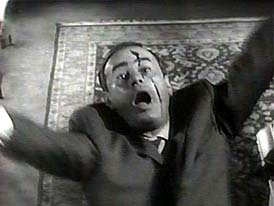
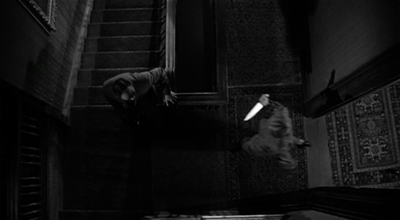
The next shot, is high angled, which captivates most of Arbogast's attack. This is one of the few shots that the audience is able to see of the murderer. The attack is shown from only a few shots in order to conceal the face of the murderer which aids in the film's amazing climax when the murderer is revealed. This shot is well set up. We see both characters and the knife that the murderer is holding, it is fully visible and is clear that Arbogast has been caught by surprise and will be killed. Lastly one of the significant camera movements in this scene is when Arbogast is falling down the stairs and camera follows his fall. His arms are flaring and his face is covered in blood and conveys terror with his expression.
Territorial design is pretty simple, there is a eye line match as Arbogast first walks into the home and he looks at the inside. The scene is kept pretty simple because their needs to be some element of surprise when we see the murderer about to kill Arbogast. For instance if the home was cover in knives or blood it would be too obvious and Arbogast would have probably left the house at that point, but if he unwisely ventured on into the house it would also be obvious that he would be killed.
The editing of the scene follows Classic Cutting. Before entering the house the cuts are long and slow, however right when Arbogast is about to be murdered we see faster and shorter cuts. One shot of this faster cutting is when the murderer is holding the knife that is about to be stabbed into Arbogast. Lastly most of the shots used for the murder of Arbogast were not used in the final film due to production codes.
The scene has relatively a lot of light for a murder scene.Darkness does not conceal the murder's face, but instead cinematography hides the person with the knife who kills Arbogast. Color is not a significant element in this extract because the whole movie is shot in black and white.
As Arbogast walks to the Bates's home dramatic music is played which adds horror and gives the audience an unsettling feeling. This is also the music that is reoccurring in the film, it was played when Marion was killed in the shower and when Bates's mother is revealed as a corpse. These rising actions had all the same song, and this benefited the film. Hitchcock even quoted, "33% of the effect of Psycho was due to the music".
The location of the extract has many interesting aspects due to the character stumbling into his own death when he enters the house of a murderer. It would have been over done if Arbogast's was also killed in the Bate's hotel, the murder would have been to similar to Marion's. An example of mis en scene is the knife, this is purposely used again so the audience can identify that this is the same murder previously seen and the location also allows the audience to assume that this the mother since Arbogast has entered the Bates's house. If it where to be shot outside with another weapon used, the audience would be confused on who is killing the characters.
One of the main symbols in the film that is also portrayed in the extract is the usage birds. When Arbogast first returns to the Bates's Hotel he looks in the office, here there is an eye line match where Arbogast looks at a giant stuffed bird on the wall, he then leaves to walk up to the house. "Stuffing birds" is British slang for sex, bird meaning desirable women, this conveys suppressed sexual desire in the film due to Norman's mother controlling his life. Before Arbogst's dies he sees this symbol, this is significant because Arbogast's figuratively sees the reason for both his death and Marion's through this reoccurring object.
The emotional information that is conveyed through the film making process is overall suspense, Arbogast had a good lead up into his murder that kept the audience watching and anticipating what was going to happen next. This scene and the character of Arbogast add another layer apprehension and is overall another element added for even more surprise for the ending of the film.
 .
.